Visible Hand by Matthew Hennessey
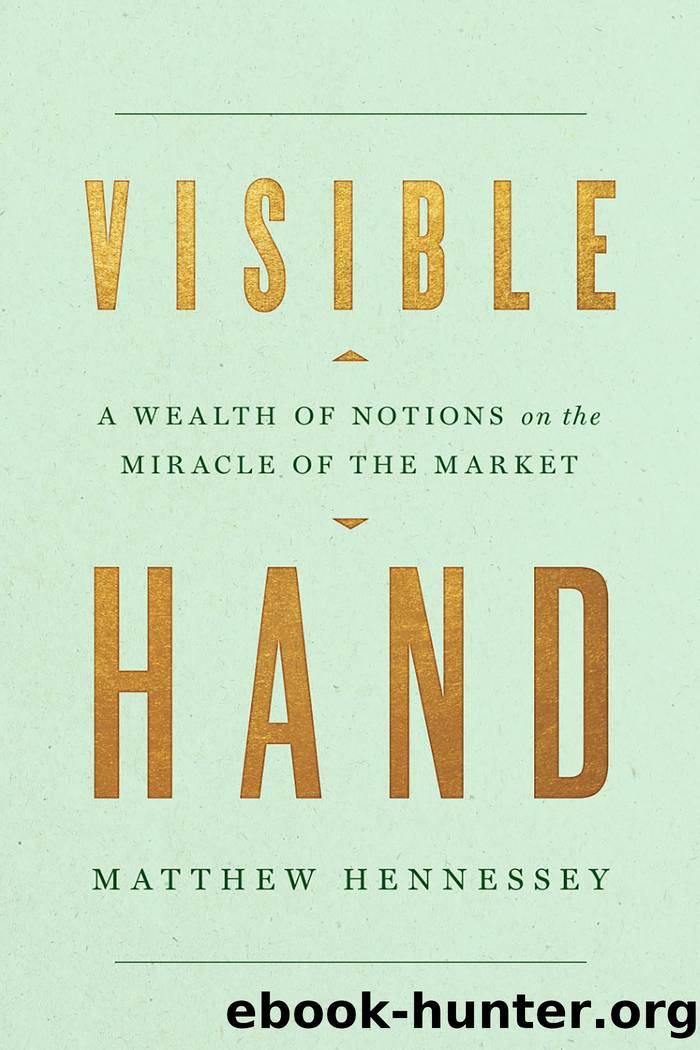
Author:Matthew Hennessey
Language: eng
Format: epub
Publisher: Encounter Books
Published: 2021-01-15T00:00:00+00:00
You Are My Special Angel
A pencil is a tangible thing, but consider what Friedman said about what weâre doing when we go to the store to buy one. We exchange a portion of âour servicesâ for a portion of âthe services that each of the thousands contributed toward producing the pencil.â Not all economic transactions involve things that get shipped in boxes or stocked on shelves.
The American economy doesnât make as many things as it once did. We are an advanced, post-industrial society. That means most of our considerable national wealth is generated by the provision of services, rather than the production of goods or the export of raw materials. Thatâs not to say that everyone in America works in an office pushing papers around a desk or mousing numbers around a screen. But for the most part the US in the 21st century is a service-based economy. Sometimes we call it a knowledge economy. Much of what our most productive workers do is intangible. That wasnât so 100 or even 50 years ago. As recently as the 1950s the American economy was primarily built around manufacturing.
How did we get from there to here? Itâs been quite the journey, so letâs go back a bit. The barter economy, based on a nomadic lifestyle of hunting and gathering, gave way to an agricultural economy about 12,000 years ago. Once people got the hang of growing their own, they began settling in one place for their entire lives and devoting their days to intensive cultivation of the land and domestication of certain useful livestock animals. They contributed their daily physical labor to the production of food and other raw materials that could then get laboriously turned into helpful things like rudimentary tools and basic clothing. It was difficult and time-consuming work, requiring hard labor from dawn to dusk, but as the generations passed, the knowledge accumulated. Farming techniques improved and yields grew larger. As people grew better at farming, they began producing more than they or their immediate family, friends, and relations could consume, leading to large surpluses that could be saved or traded. Some people had time for economically productive activities that took them out of the fields and into workshops, where they produced finished goods like advanced tools and functionalâeven fashionableâclothing. Others became bookkeepers or politicians. A few even became journalists.
Societies eventually emerged that were denser and more complex than simple farming communities. Cities grew up around the most successful settlements. Whether you were a city, a city-state, a small country, or a big empire, your success or failure often depended on how thoughtfully you exploited and consumed your natural resources, how productive your workers were, and how well you managed your trading relationships. Not much has really changed.
One natural resource that has always been key to economic success is talent, a slippery thing, hard to put your finger on but also hard to ignore when you do. People, like nations, are blessed with different allocations of talent. Everybody gets dealt a different hand.
Download
This site does not store any files on its server. We only index and link to content provided by other sites. Please contact the content providers to delete copyright contents if any and email us, we'll remove relevant links or contents immediately.
The Brazilian Economy since the Great Financial Crisis of 20072008 by Philip Arestis Carolina Troncoso Baltar & Daniela Magalhães Prates(306165)
International Integration of the Brazilian Economy by Elias C. Grivoyannis(111313)
The Art of Coaching by Elena Aguilar(53416)
Flexible Working by Dale Gemma;(23319)
How to Stop Living Paycheck to Paycheck by Avery Breyer(19779)
Thinking, Fast and Slow by Kahneman Daniel(12416)
The Acquirer's Multiple: How the Billionaire Contrarians of Deep Value Beat the Market by Tobias Carlisle(12378)
The Radium Girls by Kate Moore(12090)
The Art of Thinking Clearly by Rolf Dobelli(10598)
Hit Refresh by Satya Nadella(9185)
The Compound Effect by Darren Hardy(9055)
Tools of Titans by Timothy Ferriss(8491)
Atomic Habits: Tiny Changes, Remarkable Results by James Clear(8406)
Turbulence by E. J. Noyes(8113)
A Court of Wings and Ruin by Sarah J. Maas(7945)
Change Your Questions, Change Your Life by Marilee Adams(7847)
Nudge - Improving Decisions about Health, Wealth, and Happiness by Thaler Sunstein(7758)
How to Be a Bawse: A Guide to Conquering Life by Lilly Singh(7545)
Win Bigly by Scott Adams(7256)
